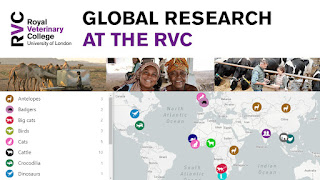
Our searchable species map
Does anyone else feel a bit flat after delivering larger scale projects? That's how I'm feeling a bit now - although there's plenty on my 'to do' list to keep me busy until we launch our next big initiative...


For the last few months we've been working on a complete overhaul of the Research section of our  university website. This was put on hold for a few months due to the response to Covid but since August it's been the main focus of the team. The main rationale behind this was:

  • To update and overhaul how our Research is showcased in line with the new structure outlined by the Vice Principal for Research and Innovation
  • To focus on Impact and better showcase strategic projects in preparation for the forthcoming Research Excellence Framework (REF)
  • To audit, rewrite and standardise all Research pages for better visibility on Google (and how people search)
  • To improve the listings and cross-referencing of projects (by species, location, group, centre and researcher)
  • To better highlight our people and the work they undertake across the institution
  • To better showcase our external partners

We are an organisation who punch high above our weight with regards to both the profile of our research and the quantity we produce. Being a veterinary college means that this is all with a 'One Health' focus. In particular recognising that the health of people is closely connected to the health of animals and our shared environment. Our process for the new section was split into six key stages:
  1. Stakeholder interviews: We spent the first few weeks talking to key researchers and external partners to determine what was important for them strategically. This helped us to categorise our research output better, standardise the layout of a project and prioritise what was strategically important.
  2. Audit: We then went through our existing website to find what could be archived, transferred over and given greater prominenece. Our website and socil media analytics data helped us to determine how people searched so we could begin rewriting our content in a more SEO friendly way.
  3. Content strategy: Primarily, this was to allow us to have a sustainable website section which is regularly updated and monitored (not always the case in the past). We prioritised key projects (in line with REF) and ensured on launch every area of the College was equally represented and visually appealing with a mix of text, images and video.
  4. Templating: After creating a new site map we then created templates for different page types (eg. landing pages, projects and listings). We provided training to our researchers on these templates so that they would supply the content in an identical format. This meant the easy creation of tags for group, lab, species and location.
  5. Build: Whilst everything was scoped to be built in our existing CMS we sourced a new solution for our searchable species map. We chose MapMe as it was the most visually appealing and easy to use for editors. Then we created a project map outlining page types, responsibilites, deadlines and whether it was a new page or one being migrated over. It was then colour coded to show progress becoming pleasingly more green as time went on...
  6. Launch - This was a bigger job than anticipated and required a lot of remapping of URLs and Google Analytics goals
The addition of the species map was the main hook of this new section as it was a unique opportunity for us to highlight our global impact as a veterinary college. Internal and external feedback has been great with many researchers now coming forward to have their projects included. 

So, did we achieve our objectives? The first month of analytics is very positive with an increase in visits by 103% and, most pleasingly, the dwell time on the page increasing by 86%. Let's hope we can continue to improve the section and do justice to the amazing work being done across the world!
What's changed for you in the last two years? When before there was a culture of everyone having to be present at their desks for 7 hours a day has your employer now embraced hybrid working? Or has that one individual who previously couldn't insert an image into a Word document now become the company expert on MS Teams?

I'm sure that everybody's workplace has, in some way, been changed by the response to Covid. For example, I'm now in a much more flexible environment that allows me to choose between home and/or office. This means I can maximise what I get done and better fulfill all my out of work commitments. I like this balance as it means I can focus on tasks when at home but enjoy working collaboratively in person. It's very hard to have creative conversations on a video call!

But what are the big changes I've seen in Digital Marketing? I spent 'Lockdown 1' coming up with solutions for online graduations/open days/offer holder days etc. Each one of these has been enough of a success for us to keep certain elements going into the future. For example, running our offer holder days online meant we tripled attendance and catered for people in different time zones saving them a long and expensive trip to campus. 

For better or worse it's meant there has been even more focus on digital solutions for problems. The positives of this are that many employees have upskilled. This has been a necessity as customer expectations have increased too due to more and more time being spent online.

This increased demand for digital skills has meant experienced marketers are much sought after. One recruitment agency I spoke to said that if we weren't offering digital marketing job seekers 4 days a week and only one of those in the office as a package (for the same salary) then there was no point trying to recruit. It's a job seekers market and they need to take advantage where they can. I've had more LinkedIn approaches from recruitment agents in the last 6 months than in the whole previous 5 years!

Alongside this there are also many well documented dangers. The counterpoint to the amount of jobs available has meant there is now worse economic equality as tech-savvy people pull further ahead of those who have less access to digital tools. Big technology firms are now more powerful than ever as the more people are online the more information they gather about society. Finally, there is a vey big danger that misinformation can be more easily spread with lies and hate speech being weaponized in order to propagate destructive biases and fears.

More than ever, we need to be discerning in what we create and what we consume. One of my main lessons from what we have all experienced is that moderation is key. Especially in how much we engage online. I have a hope that digital enagagement will be something that makes life easier whilst not ruling and manipulating people's relationships. The priority should be making slick online experiences which allow people to make up for lost time and enjoy more important human and spiritual relationships. We've all been forced to be at home more, and spend more time with family in the last two years - let's keep it that way!
After a two year hiatus I've decided it's time for me to dust off this old blog and start writing again. So why has it taken me this long? It's not that I've necessarily been any busier than usual - as life with four children is ALWAYS busy. After all, I managed to keep up with fortnightly posts when I was functioning on 3 hours sleep with a newborn...

The best reasons I can think of that I stopped are:
  1. I reached a point in my career where I wasn't necessarily constantly innovating. Instead I was quietly (for me) focusing on strategy and refining/embeding what I already knew
  2. I was trying to get my work/life balance back a bit as I got older. Of course work is important, but nothing beats family time - especially now that my kids are getting older and going to bed later
  3. The world changed forever with the onset of coronavirus. We were all trying to constantly readjust and my unschooled views on the subject would have been a pointless venture in a time when EVERYONE was publishing their opinion
So what has compelled me to start writing again now? Well, living through the response to this virus made me feel almost nostalgic for it whilst it was happening. It's evident that we're living through a time which will be particularly remembered in the history books and part of my reason for writing the blog has always been to document trends and processes. I've also now had time to build a team after a crazy few years quickly readjusting all of our activities to be online (Open Days, Graduations etc.) and leading from the front by doing most of this myself. My plan now is to settle in to being much more strategic and capture the transition.

But mainly I want to ensure I'm setting aside time to write and time to reflect. My role at the Royal Veterinary College is so busy that it's easy just to deliver a piece of work and then rapidly move on to the next. I seldom look at what has been achieved, which over the last few years has been a LOT!

I'm aiming to go back to my fortnightly posting schedule. Watch this space to see if I have the tenacity...!
This year has been rather different for me professionally. It's notable that 2019 has become the first time in 8 years that my team and I haven't won any external awards. I've been the least prolific ever with writing blog posts. I haven't presented at an industry event for the first time in 6 years. I haven't had any kind of big promotion or pay rise and haven't overseen any big flagship projects. I was a guest on my first ever podcast though...

All of this could mean that 2019 could be seen as a bit of a professional failure. So, why do I feel happier and more content than I have for years? Well, I think this comes down to changing my outlook. For instance, this year I've spent more time with my wife and children. I've been enjoying the benefits of a much more comfortable house after completing a large extension project at the end of 2019 and I've moved jobs from a potentially precarious role to one at a thriving educational institution that has so many positive stories to tell.

The latter is possibly also the reason I've been blogging less. As I've been bought in to head up the digital team it means that instead of jumping straight into the flashy, innovative work I've been quietly, deliberately, consistently trying to move the business forward. This sort of thing isn't the exciting work of blog posts and talks but involves integrating legacy systems, developing websites, embedding strategy and planning. But, it's rewarding and ultimately I see it as the best use of my time. It's a quiet sort of revolution but powerful nonetheless.

I've also noticed a decline in the content posted by external 'thought leaders' (argh!) who I regularly follow. This may be partly down to a large decline in the readership of long form posts like this one. At work I see our current social media posts getting much better engagement now we're a lot more concise with our tone of voice. The same can be said for video posts - or those with any type of movement/animation. My current favourite tool I've been trialing to bring photos to life is Pixaloop. This adds a bit of subtle movement to photos but generally sees engagement triple. I must be careful to use it sparingly though!

The reason I think we're seeing less posts on the latest flashy innovation is that digital marketing skills have evolved to be highly valued, and in many cases expected. This means that even those at the forefront are spending more time on refining existing established tools rather than bragging about discovering new ones. Those employees who fail to engage, or proclaim themselves 'not technical', are no longer given the opportunities afforded to those driving change and proving value to the business.

Initially this was a struggle for me in my new job (i.e. not being seen as the oracle) but now I welcome it. It allows me much more time to focus on 'deep work' that adds value to the business and leaves me feeling more fulfilled. I can focus on going back to basics and be clear about who we are marketing to, what they need and how we can actually help them. Turning down the volume and increasing the quality of content like this then proves very helpful in improving our audience's ever-increasing time spent online.

So, as I say goodbye to this decade I'm going to try to continue to replace expectation with gratitude. Ten years ago I had only just entered digital marketing as an industry and I wasn't even on LinkedIn or Twitter! So I am thankful that I've made the progress, and had the experiences, which I have.

Not every year can be a landmark one but as long as you're feeling fulfilled and experience one bit of joy a day it can be time well spent.
Earlier this summer was a first for me as I was approached to appear as a guest on podcast. Danny Seals was someone I met when presenting at the Digital Engagement Conference back in September 2017.  At the time, I was presenting on our new campaign and he was talking about how to use WhatsApp as a Learning Tool.

Since then we've been sharing a few tips with each other via LinkedIn and he has been a great supporter of this blog. What surprised me, after listening to him, was that Danny's background was in Learning & Development rather than Marketing. However, he has realised that Marketing is a sector which has many transferable lessons to help enhance the L&D offer. My feeling here is that Marketing gets the bigger budgets and is generally ahead in terms of measurement and technology from other related disciplines. This is generally down to access to bigger budgets due to being able to prove that Marketing is key to winning businesses in the form of new contracts and sales.

So, Danny has devised the Mindchimp podcast to chat to some of the best people in the industry to discuss what shapes them and their thoughts. In particular, learning and development, experience design, product/service design right through to marketing, communications and corporate culture.

The first series of around 25 episodes had an obvious focus on L&D professionals giving some great insight on their careers and what makes them tick. Then, as a natural evolution, the second series has more of a focus on what L&D can learn from other disciplines surrounding it (i.e. the aforementioned Marketing).

And that's where I got the call! Being on a podcast was to be a new experience to me as I'm usually the listener, on my drive to work, not the guest. There wasn't really any preparation required on my part and it was just a case of booking in a suitable time for a Skype call. Obviously I did listen to a few past episodes, just to get an idea of what I was in for, and found all of the guests to be pretty eloquent! Ouch!

Overall my experience was really good. Danny got straight in there with the challenging questions and quickly put me at ease. I did feel the pressure to answer the questions as quickly as possible so there wasn't any 'dead air'. I think I may have got a bit tired by the end too!

A few weeks ago Danny released the trailer for the new series (it was cringe-worthy enough hearing myself on there) and last Monday he got in touch to say the full episode was being released.

Overall, I am pretty happy that I gave a good account of myself, although the conversation fillers get a bit wearing ('um', and 'obviously' seem to be mine!) The one question I let myself down on was what are the five things that L&D professionals can learn from marketing. A pretty tough question when you're put on the spot (my poor excuse was that I was tired!) So, now I have the gift of time, here's how I should have answered!

1. Find champions - within any business there are people who have the positive influence and mindset to push forward new ideas and help craft new products. Identifying and engaging with them at the early stage of a project is vital
2. Use existing tools for buy-in - there's not always the need to procure a new system to fulfill a need. Sometimes the tools already exist (i.e. Instagram or MS Teams) and will take off faster if users are comfortable and familiar with them
3. Remember you're dealing with people - This is vitally important as in whatever you do digitally it is people who are the ultimate audience. So be as human as possible in the way you talk and write
4. Analyse - It's always easy to spend lots of time on what looks like doing the work. But without spending at least an equal amount of time analysing the results you'll never be able to keep learning
5. Personal projects - to properly stay relevant you need to be experimenting with your own projects. That could be blogging, design, video, photography or podcasting (like Danny!)

There's lots of places you can download the final show, and I'd definitely recommend subscribing and checking out the other episodes too:
And yes, I should have used the stockings as a fishing net!
The other week I was called a digital marketing purist. This was as a result of my recommending that we run a survey in a phased manner on our organic channels to test engagement first. The idea being that we could then see which of our followers are the most engaged, and our greatest advocates, before running any targeted posts. We could also better judge how much we'd need to spend to hit our desired amount and possibly target specific groups that were under represented in the final result.

This isn't the first time I've been referred to as a purist though, and hopefully it wasn't meant as a criticism or that I'm out of touch! What I think the person meant was that what I'm actually doing is ensuring that our all marketing is 'clean'. This is especially important to me as digital marketing can be quite a muddy environment on which to advertise. I'm sure we've all struggled in the past to get full transparency from suppliers and agencies on how something is actually performing. Clarity of impact is very important if we are to learn from, and refine, our strategies going forward.

Sometimes, getting a true measure of success can be difficult, and this is even true of campaigns we're running purely in house (i.e. without any agency support). How accurate are the statistics we're being fed by Google Analytics - and similar - anyway? In revamping our social media reporting I began thinking that some numbers are so huge (tens of thousands) that they are almost meaningless. What really matters is hard conversions which can be directly tracked back to marketing activity.

This 'clean' way of doing things means improving the user experience and having more accountability, so consumers aren’t irritated and our brand doesn’t fear fraud or misplacement. Now that I work for a brand with a very good reputation the last thing we want is for any advertising to appear on sites which are inappropriate, or not in keeping with our values. 

One way in which I haven't been so 'pure' is in the launch of our new events calendar. The cleanest approach to this would be to write a full brief for our preferred solution and then get our developers to build it all in-house. This would mean that everything existed purely in our CMS and we would have full ownership of every element - a long road I've been down before! But in researching various plug-in solutions that are available (to help scope out some features) I found something which already fitted the bill of what we were after.

Tockify is a ready-built solution that took literally minutes to configure. So after signing up for their trial I ran some tests and was very impressed with how seamlessly it all integrated. This got me thinking that if something is already built that works then why try and replicate it? The small annual cost for a solution is literally nothing if you take into account the staff time in briefing, building and testing.
There's also our users to think about. In this case we were looking to colleagues to submit and tag up their own events. Again, if something is already about as user-friendly as it gets then why try to reinvent it?

In fact, we're all using plug-ins all over our sites already. No-one would attempt to build their own website analytics platform to avoid giving Google our data. It's just important to not go too crazy with this and slow your website down!

So, maybe I am a purist after all. There is a lot to be said for keeping things simple wherever possible to deliver quicker results (something I'm still eager to do as I try to impress my new employers) and clearly attribute and track what is working for us and what isn't. 
It seems that I inadvertently chose a great time to start a new job. Back in August I was nicely eased in to a longer journey by it being the school holidays. Then parking was easier as there were no students around. I also got to experience both campuses in the sun! Most importantly though it has allowed me to experience a full academic year from beginning to end as the new students were in town for the Freshers' Fair!

I thought rather than just sample the many food vans and free sweets on offer I'd make the effort to speak to the students first hand. This then became filming some impromptu interviews where I asked about them about their initial experiences. I was amused at how excited many of the international students were about being stood in the drizzle as opposed to being in Hawaii and Florida where they had travelled from!

But their enthusiasm was just so infectious it reminded me of my own feelings, when I turned up on my first day surrounded by animals and a pile of digital strategies to write.

These students were all extremely eloquent and clear on what they would find the most challenging. Again, this reminded me of my own mental list of digital marketing mistakes I'd bought with me to ensure I avoided:

1. Failing to set goals and objectives - Without goals, it's impossible to measure success or identify areas where campaigns need additional support or require a shift in strategy. It will also be difficult to justify future digital marketing investment if progress can't be demonstrated against a set of goals

2. An inconsistent and fragmented brand on social - Years of only minimal governance can result in a variety of social channels that range in quality and consistency of posts. The trick here is to audit, lead by example and provide all of the assets that are needed to succeed

3. Too much focus on organic social presence - With organic reach declining, managing an organic social media presence across multiple accounts can be very time-consuming. The best way to get  a lot of new eyeballs on our brand is with some smart targeting

4. Accidentally competing with ourselves - With a college, a charity and three animal hospitals to market this is a real danger. There needs to be some very careful bidding strategies in place on Google AdWords

5. No forwarding planning on reporting - Retrospective reporting is a dangerous trap to fall into. Deciding what questions need answering before undertaking any activity is essential

6. Too much doing, not enough analysing - Everyone wants to look busy but already I've spent more time revising our reporting structures than posting new content

7. Not being targeted – Even the most carefully calibrated campaigns will fall flat if they’re speaking to the wrong audience. In digital marketing, audience is everything

9. Not repurposing content - cutting content in lots of different ways can ensure we get the most engagement out of everything

9. Underestimating mobile - When working on a shiny new Mac it's easy to forget that the majority of the content is going to be viewed on a little screen.  Mobile must be a consideration in everything your brand does online

9. Not converting web traffic to leads - Whilst Google analytics is an essential tool I'm on a mission to try to cut generic reporting from  our monthly reports. This is because the statistics that matter are the hard leads and conversions from our CRM

10. Not being helpful - The death of any piece of content

Seeing the new students and visiting the hospitals has put my own job into perspective.  By keeping these major missteps front of mind it can save time, money, and stress, and help make our campaigns more fruitful in the long run. 
And so continue my adventures in Higher Education and I'm back in the vortex!

Many moons ago, back in 2016, all universities were required to add Key Information Sets (KIS) widgets to their course pages. I remember this well, as at the time, it was a lot of work for us and our many courses. The only sweetener was that the horrible red widgets at least matched our brand colours at the time! These comparable sets of data, about full or part time undergraduate courses, were designed to meet the needs of prospective students as a standard way of displaying this information.

So last week, I get an email from Unistats saying that these require their first major update in 3 years. It's like they knew I was now back! Whilst the technology gets more sophisticated policy doesn't change.

The same is true of the accessibility statements I've been writing for our website. In September 2018 (whilst I was out of the game) the UK law changed for all public sector bodies to adhere to the EU directive on web accessibility. Whilst this doesn't officially need doing for older websites until next September I've been trying to get ahead of the curve and get ours published this month.

The government will be monitoring all public sector websites to ensure we have these published and are clear on what works and what doesn't.

Whilst I'm not a fan of unnecessary policy this is definitely a good thing to ensure that our websites and apps work for an audience with a disability. Importantly, it ensures that my upcoming website roadmap will have accessibility as a key deliverable and is taken seriously. It certainly makes a change from the public sector where budget was a bigger consideration than the usability of the site!

So with all this policy, the challenge is making higher education websites, and campaigns, stand out from the rest. My new favourite parody account summed this up perfectly in a recent tweet:
The really exciting thing about my new role though is that we do have a clear differentiator. All of the cute animals! These are a marketers (and social media managers) dream so the pressure is on to really make the most of this great content. In fact, we have so much potential content that I've been surprised how small the institution is compared with how I perceived it before I started.

So, to not get ahead of myself I've been spending a lot of time putting in some strategy to leverage this all properly. Whether it be the plans for the website, CRM, or intranet, these channels must come first as this is where we drive all of our traffic.

This isn't to say that I haven't had a look at tightening up our social media posts tone of voice, imagery and reporting. This is important to put a marker down on where I think we'll be going in the future and I've also wanted to demonstrate to my new colleagues that I am doing and not just planning! I particularly enjoyed getting involved in some animations for our Clearing campaign and ensuring we had some great posts lined up to drive engagement on #InternationalDogDay last month:


It's hard holding back when the temptation is to try to fix everything at once but setting goals, asking questions and understanding if things are worth doing in the first place and the ways I'm really going to make an impact in my new role.
Four an a half years ago I wrote a blog post outlining my top 5 tips for starting a new digital marketing job.

Now I've left the glamorous world of construction marketing and returned to education marketing at The Royal Veterinary College and many of them still stand. That's right, I'm back in Higher Education and what an amazing place to work it is!

In many ways, after my time away from the sector very little has changed. It's as competitive as ever, there are all the same acronyms and there is still the same amount of policy to wade through. Where I've noticed a difference is in the type of institution I'm working for. For a start, clearing isn't a thing here and the students around campus are massively more hard working, eloquent and intelligent than I'll ever be.

Then of course, there's the animals. Lots of them. In my role I'm responsible for helping market the small and exotic animal hospitals as well as student recruitment. This definitely fulfills my ongoing desire to market something which actually makes a difference to people's lives. The work the professors, doctors, nurses and students do is truly world class.

The hardest bit for me has been going from a job where I understand the business, know my stakeholders and have configured all of the systems, to inheriting new ones. In some ways they're better (all CMS systems have their eccentricities) and in others I'm all at sea.

In my first week, and for the first time in a good few years, I picked up a new system and couldn't immediately get to grips how it worked. This was an uncomfortable feeling and I immediately started to feel that maybe this was the point when I'd lost my touch.

I'm not usually one to pay much heed to the many motivational quotes that are shared around the internet but I saw one the other day that made me feel a lot better.

"I'm not lost, I'm just at the beginning of the journey".

I knew there would be lots to learn in a new job and one of the reasons I needed a change was to be challenged again by people I could bounce ideas off and have healthy debates with. As long as I make positive progress each day then that's enough at this stage.

For now, I'm taking the approach that the best way to learn is by doing. Thankfully I have lots of projects I've either picked up from others, or see the need to instigate myself, in order to do this. The fact I've still got lots of drive and fresh ideas shows I'm not washed up just yet!

The other danger is that I set an early precedent for bad habits like not going for walks or leaving my desk to eat at lunch. The big problem with office work can be that thinking doesn't look like working to others. I've proved this to myself already but cracking a technical problem in my head during a lunchtime walk and having my most productive afternoon's work for ages after enjoying a particularly delicious lunch of beef tacos in the campus restaurant.

So with all this in mind I'm going to make a few promises to myself:
  1. Blog more regularly (writing this has been quite therapeutic!)
  2. Be thankful that I'm being paid to learn
  3. Appreciate my surroundings and the great work of the company I now belong to
  4. Don't spread myself too thinly in an attempt to immediately try and impress everyone
  5. Eat more tacos
At school my favourite subject was English - I remember putting way too much effort into my short stories compared to the rest of my work. I used to enjoy art as well and combined the two by also illustrating every story I wrote. In fact, when I recently discovered my old history books, at the back of the garage, it was obvious that I'd spent more time drawing pictures of Anne Boleyn's six-fingered hand than actually demonstrating what I'd learnt.

I used to continue this at home by illustrating comic books and writing more stories. I sort of still do by continuing to write this blog! I think that part of this is my drive to try to create more content than I consume. But with so many distractions around it's not an easy thing to do. I'm by no means the best writer, or even a very good one, but I do enjoy the evolution from writing for school to writing for business. With the former, I used to finish an assignment and hand it in. Whereas with blogging, I find I can create something and iterate on it with a goal of always improving.

But writing content for the web is HARD. Just because you work in PR, once wrote a book or even have your own blog it doesn't mean you can write web content. I became so bogged down with it during a recent website rebuild project that we decided to brief and outsource it to copywriters. So, here are a few pointers, which I always try to stick by, when writing for the web:
  1. Don't start by thinking about what you want to say but what people want to know. You need to decide immediately on your target audience and identify their pain points.
  2. Think about the purpose of your website/blog and the page you're writing for. Is there something you can offer different to your competition (i.e. some relatable examples?)
  3. Stick to your brand guidelines. Every large business should have a style guide which needs to be adhered to for a consistent tone of voice. It may take longer at first, but writing in different styles (personal/professional) will eventually become easier. 
  4. List and include your keywords. Before writing anything compile a list of prioritised keywords to ensure your content is found. There are lots of different ways of doing this and using social media to 'listen' to your audience in advance is an important one. 
  5. Make your writing visual. People read very differently online. It's important to ensure that you break up sections with sub-headings and lists to avoid reader fatigue. 
  6. Ensure that your content helps visitors through the conversion funnel. Anything you write should engage and involve your readers. This is especially true in blog posts where you want to present an interesting idea and spark debate. 
  7. Edit and proofread and have someone else read your draft. My wife is my long suffering sub-editor! You should also be clear about what you want the reader to do once they've read the article and link to relevant content elsewhere within your site. 
  8. Make sure your article is easily summed up for social sharing. If you focus on keeping your content focused and about one subject this should be much easier.
So it's time for me to publish this post and ensure I've done a decent job of summarising it's content for Twitter and LinkedIn. 

Now I've put myself out there by documenting my process let the stream of social media comments on how badly written this post is begin!
Any business, whether they have an active presence or not, needs to pay close attention to their online reputation management (ORM).

It's very likely people may seek out your reputation before making, buying or entering into contracts with you. If there’s no information online about your business, then whilst this may not be damaging in itself, your brand may not be getting the same coverage as competitors.

But it's not just a case of setting up some social media monitoring, or increasing your focus on public relations. Your brand is constantly being talked about either on review sites, on social media or by getting media coverage.

So what do you do if your online brand reputation suddenly decreases with negative news articles appearing as the top Google results?

Google’s ‘Top Stories’ feature means that if your company are in the news (by high traffic sites news specific sites such as BBC) this is prioritised at the top of any search for your brand for a maximum of 5 days.

There are things that can be done to decrease the prominence of these results and affect the top five listings in Google. Especially as they receive about two-thirds of all clicks from users.
Here are some very quick wins to ensure your own content is ranking well which don't require any additional external spend:
  • All website blog posts and news releases should contain images, which Google likes, to ensure content is ranked well
  • Adding referral links to other pages on your website from your news releases increases your Google ranking - it does not like dead-end pages
  • Where possible, ensure that you are the first to publish any news stories to achieve a better  ranking
  • Track all live mentions on social media, via Google Alerts and a media monitoring tool (i.e. Brand Watch) to tackle any media issues
  • Post content on more contentious subjects and speed up the publication of certain high-ranking news article topics
  • Upskill those publishing content using online tools to do extensive keyword research and web specific writing using tools like Keywords everywhere, Headlines analyzer and Hemingway app to ensure content is ranked better by Google
  • Deliver training on updating LinkedIn profiles to educate the business on optimising their personal profiles
  • For crisis control you can create bespoke webpages which clearly state the issue, are transparent and can provide up-to-date information about the actions being taken
Of course, your social media presence is very important and you should optimise your profiles and ensure you are posting regularly at the very least.

If budget isn't an issue you can undertake Pay Per Click (PPC) activity via Google AdWords to further control what appears at the top of Google searches and relegate the problematic ‘Top stories’ section.

Many B2C brands do this and essentially bid for their own brand name as it also allows them to have sub-links to key parts of their website. Keyword research will show your most searched for terms and the cost per click (CPC) in order to rank first. This CPC is determined by other companies bidding for the same/similar terms and search volumes.

Of course, an essential element of a successful ORM strategy is measuring success. Therefore you'll need to track and report on:
  • Key web influencers which could potentially be targeted to run content with as identified by Brand Grader
  • How paid and organic activity has affected brand sentiment (positively or negatively)
  • If your website traffic has increased meaning more users are visiting for news updates rather than third parties
  • How many clicks you have received on your ads as a percentage of searches (which previously would have gone to third parties)
  • Social media complaint increase or decrease
The key thing to remember is that your brand is being talked about and it's up to you to ensure that these mentions are truthful and positive!
Earlier this year I ventured out of the office in the drizzle, and donned my high-vis, to be given a live site tour. The Bolanachi building in Bermondsey, London is where our Housing Maintenance team are currently working hard to make it fire safe. This includes replacing the exterior cladding and meticulously checking every flat and balcony.

I'm always impressed with the enthusiasm of the teams on these projects. Especially when a well planned and methodical approach is essential. There is the ever-changing nature of a project like this where client and government brief alterations can force changes to the brief and deadlines. Liaison with residents is also very important so that there are no surprises - in this case being comfortable enough to let our teams into their homes.

One particularly striking conversation was when the project manager told us about his operations officer. He said that he was the most trustworthy and productive colleague he had ever worked with.

As usual, this visit got me thinking of lots of parallels to my own (admittedly more cushy) desk job. In particular how we're all trying to do less with more. All of the companies I see recruiting are looking for that individual who will stand out and be different from the rest. Someone like this operations officer who has the ability to cover when another person is ill, or on holiday, someone who is willing to learn if they don't know.

In a recent meeting with our marketing placement student I said that as a manager a really important skill to see in my team is to proactively find and solve problems. Even if the solution isn't perfect it's a really striking skill when most people wait to be told what to do.

We've all had an experience where we've been asked to help, perhaps an elderly relative, with a technical problem with a computer. Whilst it may not be something we've done before, or know how to do, we give it a go anyway, try some troubleshooting and eventually solve the problem. This is a lesson in why we shouldn't shy away from applying for any job which we want!

When recruiting for any role the most important thing to look for is this type of attitude. People can learn how to use software applications which they don't know how to use but it's a lot harder to change their attitude.

As well as this there are also some key skills which I feel make for the best digital marketers:

1. An understanding of the business and what makes the most money

To effectively market a business it needs to be properly understood. This helps when working out on which activities it is best to spend time. Then it's possible to actively prove worth and immediately begin to add value.

2. Not making things look complicated to make you look clever

This is particularly true in digital marketing which can traditionally be seen as an area best left to the technically minded. Taking the time to sit down with your team and show them how things work and why is really important.

3. Happy to be held accountable

Along with problem solving this is an attribute which definitely makes people stand out from the crowd. If leaders demonstrate it themselves then this is the best way to embed this into the company culture.

4. The ability to navigate a complex business

This became more evident to me when working on our website rebuild project. The ability to not get bogged down by internal structures and to simplify and be user focused is essential. There will always be conflicted demands but knowing how everything interrelates (or doesn't!) helps streamline how you work.

With an attitude that encompasses these four points it should definitely make a more effective marketer both as an employee and as someone who has a user-focused outlook.


Now that our revised social media strategy has been rolled out across the company it's time to ensure regular measurement! With planning tools in place, and clear guidance to contributors, it's essential to see if our recommended strategy works in practice.

But with digital now just another part of the marketing mix shouldn't all marketing contributors be able to do the basic of reporting on their work themselves?

Given my role as the in-house digital marketing lead I've always thought of myself as a generalist. By having an understanding of other channels it allows me to grasp a whole marketing strategy and know what we're working towards. There's no way one person could master all 50+ channels anyway! I've been responsible for telling my colleagues or manager how a piece of content written a month ago is performing. That's why in this case I have been responsible for setting clear objectives and then creating/populating a regular dashboard for the team to monitor progress.

The danger of this all sitting as my sole responsibility is it doesn't give my colleagues the power to truly demonstrate their value to the role/company. If others can't, or don't want to provide analysis on the performance on the success of their work how can they show they're contributing to the most basic of marketing and business goals?

Whether a content writer, copywriter, SEO copywriter, or a blogger if you're not reporting on the content you have created you're not fully understanding its success or impact. Therefore, you're also probably not improving and could potentially be held hostage by a single person’s (the reporter's) absence. This is a dangerous place to be in an industry that is becoming increasingly demanding.

In fact, with the majority of jobs piling on the stress most companies are now expecting more from their applicants. They want someone who has the ability to cover when another person is on holiday, or ill, someone who is willing to learn if they don't know. Everyone in this industry must be able to do at least some basic reporting, to show how their content has performed, otherwise they will never stand out from the other hundreds of applicants.

As a generalist, where I need to improve is to not only have a light level of knowledge in a broad array of skills, but a deep knowledge/ability in a single one (or a few). It is natural to crave mastery in the workplace so if I find myself constantly shifting gears between surface-level tasks in multiple practices I will never have the chance to develop the mastery of one particular area.

It might also mean I don't earn respect from experts, leading to a lack of support and push back on initiatives. The level below this being those who have a very deep understanding of one thing (i.e graphic design) and haven't built a basic competence across disciplines. These people then have a hard time building value in a team environment.

The best team members are those who can tackle diverse projects with creativity and agility while maintaining high effectiveness. Only they know enough to implement the knowledge of experts and when to bring them to the table. This is an area I particularly need to work on.

Coming off the back of two big projects (website and a social media review),  has allowed me to begin to recognise when and where deeper expertise is needed and the wherewithal to bring it to bear on my projects. All digital marketers stand on the shoulders of giants.

The web is a vast library of knowledge and tools, instantly accessible, served up by people who dive deep into topics, build solutions and share them with the world (often free of charge). Having the ability to adapt and adopt where I can't build is key. Being an in-house digital marketer without a lot of internal support, I need to focus on cultivating a network of specialists I can turn to when a project fits.
Whilst trying to revamp our social media strategy for 2019 one thing has become clear. That we needed to arrive at a focused list of actionable goals. As soon as we began the research it was obvious that this stage could snowball into a massive project in itself with no defined end or list of recommendations. So, rather than try to solve everything in one foul swoop it made sense to begin testing our main conclusions to then set us up for phase 2...

So what initial conclusions have we swiftly arrived at? During the process of looking at our own social growth last year, and comparing it to competitors, we saw that best practice existed out of sector. We also gained a clear view of which content type and time of day was working. By mapping these content types against parts of the business we immediately came to some quick conclusions:

1. Not all channels were working for us -
this is why we made the decision to retire our Facebook and Instagram accounts. As a B2B business the former was showing no ROI whatsoever in 2018. So why persist with it? With regards to Instagram, this is something we do intend to revisit soon. But, without a clear channel specific strategy it ran the risk of just regurgitating content from other channels. It's a truly visual medium where we need to cultivate a different group of followers and showcase some beautiful photos for it to succeed.

2. Channel specific strategies are essential - By concentrating on fewer channels it means we can address them properly. In some cases we were guilty of using the same content, imagery and tone of voice across all platforms. By looking out of sector I've seen some brilliant examples of how to maximise the use of Twitter in particular. In the next few weeks we'll be putting this to the test as we develop a unique and bold voice with the aim of keeping it simple. We can then quickly evaluate if what our research is showing us is correct.

3. Guidance for contributors - with an increase in employee advocacy we need to be encouraging sharing wherever possible. Sharing good news can be so much more powerful coming from an individual than a company. This is why I've been working on a series of training sessions and documents to help colleagues make the most of their LinkedIn profiles. I'm also deep into writing guidelines for direct contributors to company accounts.

4. Templates for consistency of brand - this guidance document contains lots of good and bad practice examples of tone of voice and emoji usage. I've made a point of referring to the latter as 'iconography' as this should avoid the danger of them being used in a more frivolous manner. We've also identified the top content from the last year which we can signpost with templates to make it visually appealing (e.g. blog posts, awards wins and press releases).

5. Clear objectives and ownership - I've been very careful to ensure that all activity is SMART. With regular review dates in the diary this also means we can get an idea early on if the revised strategy needs adjusting. For each of our channels we have seen the need to appoint local owners who we will support in proving that their account is worth their time and has a clear ROI.

6. Workflow and planning - As a central team we need to govern what is shared whilst still allowing the business to retain this ownership. By setting up tools which allow clear planning posting and approvals we can then oversee the content before it is posted. This helps us educate the business as we go along meaning all of our goals are met.

These are some of the tactics we'll be putting into practice in the next few weeks and we'll be evaluating them as we go. Keeping up to date is essential in any type of marketing so watch this space to see if we find this newly formulated plan has worked or is badly misjudged!
A lot is made in the media of young entrepreneurs who become massively successful in their early twenties. Whether it be social media influencers, or leaders of new tech start-ups, these people are raised up as examples of a vibrant tech-industry. We have a high-profile YouTuber living in our village and his BMW i8 always gets our children's attention when charging on his drive!

I was actually pleasantly surprised on Friday. I spent the morning talking to 120 year nine students at Longsands Academy in St. Neots about my career path. They were generally quite mature and none of them had career aspirations as a YouTuber. This is at odds with the survey published last year saying that 75% of young people wanted to follow this career path. In fact they were all very respectful and many seemed genuinely interested in the subjects they needed to choose to succeed in their careers.

The issue with the media either exaggerating or over-promoting the people at the top of the tech-ladder is that older talent is getting overlooked. This can be particularly true in marketing where 'old' appears to have little value either in the workforce or as consumers. The need to reward and nurture young talent is obvious but we should also be celebrating the career-long achievements of the talent who continues to deliver the creative work that drives this industry.

When it comes to the digital economy, especially, the hard-won experience of those that actually built this industry, is even more vital. It's one of the reasons why there continues to be research pouring out proving that the most successful tech founders aren't actually the startup kids of popular myth but those in their forties and fifties.

Why would you not hire people who have the experience, the understanding, the success (and the failures of the past) to make the company better? They are mentors to youngsters, wise heads to steer business thinking, and talent that adds benefit to the bottom line.

Reliving his youth
I quite often hear 'I'm too old' as an excuse of why an individual is not happy adopting a new way of working or a new software program. This doesn't help this cause at all. Especially as in my experience my generation is not growing up! All of my friends, acquaintances and work colleagues are in many ways acting the same as they did in their twenties and thirties, spending time and money on the things they have always enjoyed. Many still playing video games and listening to the same genre of music they did in the 90's.

The danger here is that the desperate cult of youth means makerters also don't see this demographic as a viable target. Instead we continue to court the millennial generation at all costs. Of course, brands need to try and win the lifetime loyalty of their future customers but the incredible behavioural shifts we've witnessed over the past decades seem to be ignored by a marketing industry that prides itself on a forensic understanding of human behaviour.

While 78% of over 50s are in charge of their household spending, with the age group accounting for half of all consumer spending in the UK, brands continue to ignore them or peddle a desperately out of date, cliched view of the generation. The view of over-50s is that brands aren't interested in them unless they're selling anti-wrinkle cream or Saga holidays.

My father used to call me 'Peter Pan' due to my apparently childish hobbies and fear of commitment. I can safely say I've moved on a bit now I'm mortgaged up to the hilt with four children. But I still enjoy spending my spare time on the same activities I did when I was younger. It's time for the marketing industry to begin maturing itself to see the benefits of targeting the older generation both with their products and their most influential jobs.
In my role I'm frequently expected to be up to date with all of the latest digital tools and tips. I've actually started to make a point of this in the last few weeks with my '#factfriday' posts on Microsoft Teams. Every Friday I post a new tip (i.e. my latest is a little workaround to extract images/videos from PowerPoint presentations) to try to make the lives of my team easier!

This means I'm often the first person tasked with trying out and testing new tools. For me though, it's as much about how something works as why we may need to use it. Yes - there may be a great new cloud document management platform that IT are supporting but unless there is buy in from the whole team it won't take off at all.

I remember an old colleague telling me that when email was first introduced nobody saw the benefit. Work was getting completed just fine with the methods already in existence. So, to force everyone's hand it became the only way meeting appointments and minutes were communicated. Everyone had no choice but to check it regularly, or risk being completely out of the loop. Fast forward a few years and we exist in a world where many people's inboxes, still are, an overflowing nightmare! Now my goal is to disown email where possible with tools like MS Teams and Slack being preferable. 

But, as above, all it takes is for one person to not be invested in changing their working habits to cause complications. Again, I remember an old senior manager of mine printing out all his emails on a Friday. He then put them in his briefcase to read over the weekend, draft responses and give to his PA to type up and send. That's added admin and slow response times for all involved!

The subtext behind being told you need to train everyone on a new piece of software can be one of two things:
  1. "This new thing is so bizarrely new that no adult Earthling could possibly figure it out without formal training" OR
  2. “This new thing is a pain in my neck and I don’t know how to introduce it. I’ll have someone in the team train everyone and call it a day"
Either way, the expectation is that you to unleash an avalanche of 'training' on innocent people who would rather just do their jobs. Before training commences it actually makes more sense to give the new software to a few people who would benefit most and watch them figure it out. Their struggles (or lack of struggle) will show what support they really need. A help screen or short reference is likely to be enough “training” in this case.

When introducing Trello as a tool, a number of years a ago, we set clear goals as to what we wanted to achieve. These weren't simply to mandate an in depth training session for everyone. Instead we set measurable goals such as eliminating handover meetings, reducing emails by 20%, allowing more remote working and reducing the reliance on flaky shared drives.

These goals didn’t assume that training is the answer, and they justified the expense of the project in terms the organization cares about. It also left room for many solutions, including job aids.

I'm pretty much self taught on most of the software I use. Some of it I'm better at than others, but I like to think that I've made a point of learning those features which are most beneficial to my job. I probably only use about 60% of the features of most of these and I always start with a task I'm looking to achieve before selecting the best way to do it. This can be asking a colleague, watching a video or clicking about hoping not to break something!
Next PostNewer Posts Previous PostOlder Posts Home